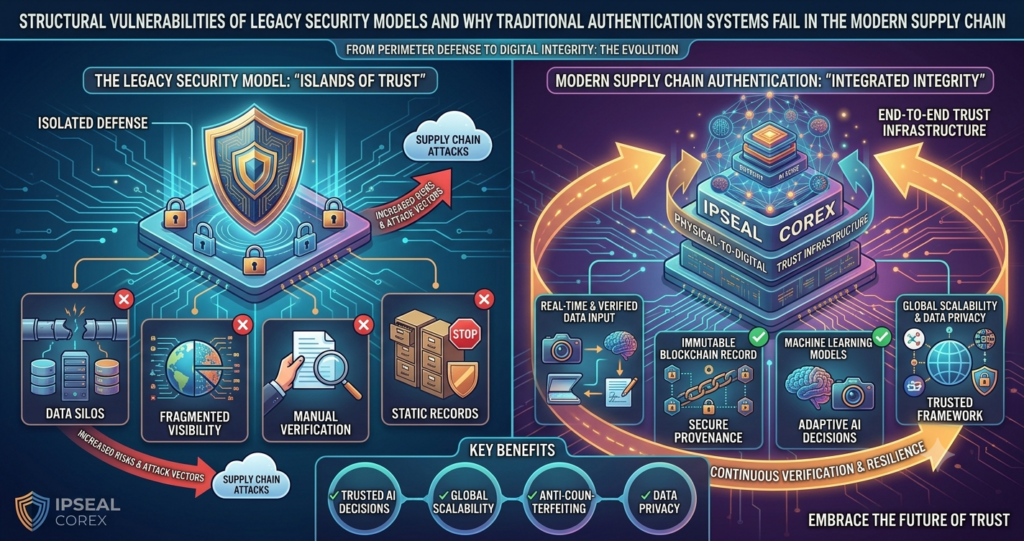
As global supply chains expand in velocity, volume, and geographical reach, the threat of high-grade counterfeiting, unauthorized factory overproduction, gray-market diversion, and intellectual property theft has reached unprecedented levels. Historically, enterprises have relied on traditional authentication methods to defend their physical assets. However, these legacy systems—spanning static optical codes, passive RFID tags, holographic stickers, centralized databases, and disconnected paper certificates—were designed for an outdated industrial model. Modern counterfeit rings now routinely exploit the inherent flaws of these legacy technologies.
To demonstrate why enterprise brand protection requires an immediate paradigm shift, IPSEAL.NET presents a comprehensive architectural breakdown of legacy security failure points. Built upon the computational and artificial intelligence foundation of our independent entity, Entrupy, the Ipseal CoreX platform overcomes these structural limitations by unifying dynamic hardware cryptography, deep physical material vision, and decentralized legal consensus into an unbreachable defense matrix.
1. The Anatomy of Failure: Structural Vulnerabilities in Legacy Systems
Traditional anti-counterfeiting mechanisms fail because they treat security as a static surface label rather than an intrinsic, multi-dimensional property of the asset.
┌────────────────────────────────────────────────────────────────────────┐
│                   LEGACY AUTHENTICATION FAILURE POINTS                  │
│                                                                        │
│   [ STATIC OPTICAL CODES ] ──► Easily Photocopied & Cloned            │
│   [ PASSIVE STATIC NFC ]   ──► Vulnerable to Signal Emulation          │
│   [ OUTER SECURITY TAGS ]  ──► Subject to "Tag Peeling" & Transplanting │
│   [ CENTRALIZED DATABASES] ──► Cloud Latency & Internal Manipulation   │
│   [ PAPER CERTIFICATES ]   ──► Disconnected from Regional IP Laws      │
└────────────────────────────────────────────────────────────────────────┘
2. Deep Dive: Why Traditional Security Models Collapse
Vulnerability A: Static Payloads vs. Optical and Signal Cloning
-
The Legacy Mechanism: Standard QR codes, barcodes, and basic static NFC tags broadcast identical text strings or URLs on every scan.
-
Why It Fails: Counterfeiters simply photograph high-resolution QR codes or copy static NFC serial numbers onto cheap commodity chips, attaching them to thousands of replica products. Because the scan payload never changes, static verification databases accept the fake scans as genuine.
-
The CoreX Defense: The Ipseal CoreX powered by Entrupy engine replaces static strings with NTAG 424 DNA silicon enclaves. Utilizing Secure Unique NFC Message (SUN) technology, the chip generates a mathematically unique AES-128 cryptographic hash on every single tap, rendering replay attacks and optical copying impossible.
Vulnerability B: Single Outer Labels vs. “Tag Peeling” & Part Substitution
-
The Legacy Mechanism: Legacy systems affix a single holographic seal or security sticker to the external packaging or outer chassis of a product.
-
Why It Fails: Fraudsters easily peel authentic tags off genuine products and transfer them onto counterfeit items (“tag transplanting”). Alternatively, they replace valuable internal components while leaving the outer shell untouched.
-
The CoreX Defense: CoreX deploys AES-GCM 256-bit encryption to execute a joint Parent-Child token handshake. The outer identity token (Parent Key) is cryptographically bound to deep internal component tokens or physical material feature vectors (Child Keys). If a tag is detached or an internal part swapped, the mathematical balance breaks immediately.
┌────────────────────────────────────────────────────────────────────────┐
│                      LEGACY vs. COREX COMPARISON                       │
│                                                                        │
│  Traditional Systems:                                                  │
│  Static Code ──► Central Cloud Query ──► High Latency / Easy Clone     │
│                                                                        │
│  Ipseal CoreX Ecosystem:                                               │
│  Dynamic SUN Chip + AI Micro-DNA ──► Edge Node Consensus ──► Sub-ms    │
└────────────────────────────────────────────────────────────────────────┘
Vulnerability C: Centralized Cloud Dependencies and Latency Bottlenecks
-
The Legacy Mechanism: Traditional systems query centralized cloud databases to verify serial numbers.
-
Why It Fails: High-volume customs checkpoints, automated factory lines, and logistics hubs cannot tolerate cloud latency. Furthermore, centralized databases present single points of failure, vulnerable to cloud outages and database tampering.
-
The CoreX Defense: Driven by our 10th-Generation Central Core, independent validation nodes process complex cryptographic handshakes and AI vector matching locally at the edge in sub-milliseconds, ensuring zero system lag and complete offline resilience.
Vulnerability D: Disconnected Paperwork vs. Regional Intellectual Property Fraud
-
The Legacy Mechanism: Product authenticity is often attested via paper certificates, localized stamps, or static PDFs.
-
Why It Fails: Paperwork is easily forged, and static certificates fail to enforce geographical distribution boundaries, enabling illicit parallel imports and gray-market diversion across borders.
-
The CoreX Defense: Managed under our Entrupy standard, national trademark registrations, class approvals, and localized distribution rights are audited, hashed, and locked directly into the product’s digital passport—intercepting regional legal breaches automatically at edge nodes.
3. Executive Differentiator Matrix
┌────────────────────────────────────────────────────────────────────────────────────────┐
│                        LEGACY SYSTEM vs. IPSEAL COREX                                  │
├───────────────────────┬────────────────────────────────┬───────────────────────────────┤
│ ARCHITECTURAL FEATURE │ TRADITIONAL SYSTEM             │ IPSEAL COREX POWERED BY ENTRUPY│
├───────────────────────┼────────────────────────────────┼───────────────────────────────┤
│ Data Payload          │ Static / Copyable              │ Dynamic AES-128 SUN Token     │
│ Component Locking     │ None (Outer Label Only)        │ AES-GCM 256 Parent-Child Matrix│
│ Physical Inspection   │ Surface-Level Optical          │ AI Microstructural Fiber DNA   │
│ Processing Topology   │ Centralized Cloud (Slow)       │ Decentralized Edge Mesh       │
│ Legal Enforcement     │ Paper-Based / Disconnected     │ Embedded Regional IP Sync     │
│ Error Threshold       │ High False Positive Rate       │ 99.98% Accuracy Precision     │
└───────────────────────┴────────────────────────────────┴───────────────────────────────┘
Conclusion: The Transition to Mathematical Asset Sovereignty
Legacy authentication systems fail because they rely on static indicators in a dynamic, highly sophisticated world. By moving beyond vulnerable barcodes and centralized databases, the Ipseal CoreX platform, powered by Entrupy, delivers a multi-layered security matrix that binds physical matter, dynamic hardware cryptography, and regional statutory law into a single, unbreachable ecosystem. This optimized architecture ensures that physical assets remain authentic, legal rights are fiercely protected, and global commerce operates with absolute, unshakeable trust.
