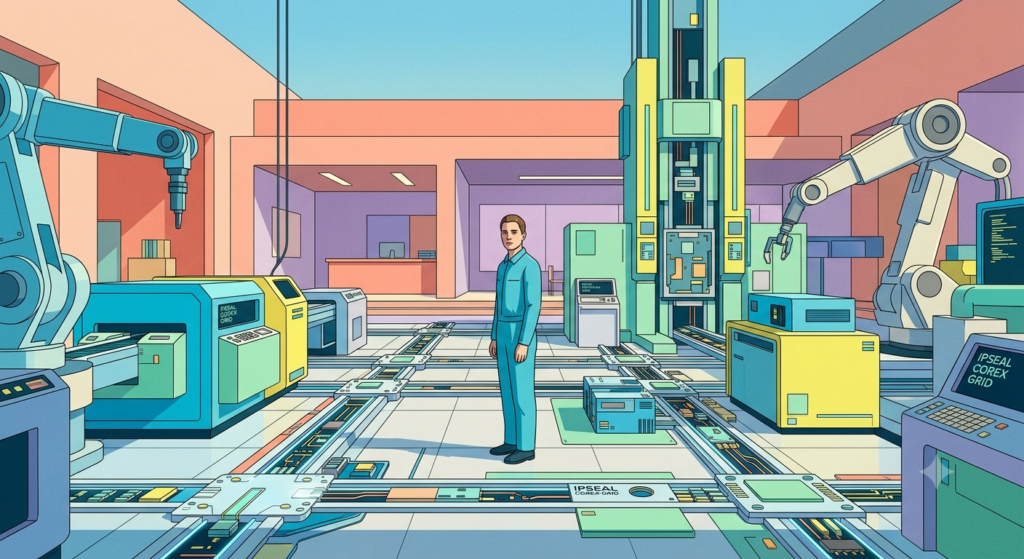
In global enterprise asset protection, security cannot be treated as a secondary addon or a post-production layer. Waiting until a product is finalized and packaged to apply tracking indicators leaves a critical window open for inventory leakage, overproduction fraud, and unauthorized product substitution. To secure an item completely, its cryptographic identity must be forged at the exact moment of creation on the workshop floor. IPSEAL.NET addresses this vulnerability by deploying its validation architecture directly at the beginning of the manufacturing line. Driven by the high-performance Ipseal CoreX platform and verified under our proprietary entity, Entrupy, this factory-first framework injects secure cryptographic twins into physical assets from their inception, establishing an uncopyable root of trust.
1. Phase 1: Material Onboarding and Microstructural Fingerprinting
The initialization process within the Ipseal CoreX powered by Entrupy grid begins the exact millisecond raw materials enter the assembly ecosystem.
[ Raw Assembly Line ] ──► [ CoreX Microstructural Scan ] ──► [ Numeric Feature Vector ]
                                                                       │
                                                                       ▼
[ Parent-Child Init ] ◄── [ AES-GCM 256 Key Binding ]   ◄── [ Hardware Token Injected ]
-
Early Microstructural Scanning: Before fabrics are sewn, hides are cut, or components are molded, localized edge cameras and optical scanners perform a high-resolution analysis of the base materials. The CoreX neural engine maps the biological fiber randomness or material density variations, establishing a unique physical footprint that separates authentic materials from uniform synthetic replicas.
-
Generating the Digital Twin Vector: This microstructural profile is instantly converted into a compressed numeric feature vector. This data package serves as the digital birth certificate of the material batch, preventing unverified or lower-grade materials from being swapped into the line later in the cycle.
2. Phase 2: In-Line Assembly and Parent-Child Token Marriage
As the raw materials move down the active production line and are constructed into finished goods, the system layers on its core physical-to-digital defenses.
A. Deep Token Embedding
During the structural assembly phase, secure hardware tokens are physically embedded into the product (such as inside the sole of a shoe, deep within a luxury bag lining, or beneath a garment label). Because this happens during mid-production, these tracking elements become part of the item’s physical structure, making them impossible to remove or modify without destroying the asset.
B. Bank-Grade Cryptographic Handshakes
The moment the tracking components are structurally attached, the factory-floor CoreX node triggers a joint asymmetric validation protocol utilizing AES-GCM 256-bit encryption. The primary outer identity anchor (Parent Key) and the deep internal tokens (Child Keys) execute a mutual challenge-response handshake. This mathematical link locks the various parts of the product into an inseparable, unified identity matrix.
3. High-Velocity Edge Testing and Automated Quality Control
By embedding security directly into early-stage manufacturing, corporate groups establish an automated, objective standard for lifecycle asset protection:
┌────────────────────────────────────────────────────────────────────────┐
│                   FACTORY INCEPTION ADVANTAGES                        │
│                                                                        │
│  1. SUB-MILLISECOND LINE SPEEDS                                        │
│     Executes token initialization locally with zero factory delays.    │
│                                                                        │
│  2. TOTAL ERADICATION OF ILLEGAL OVERPRODUCTION                       │
│     Ensures unchipped or unmapped batches can never pass distribution. │
│                                                                        │
│  3. IMMEDIATE BLOCKCHAIN ORIGINAL MINT                                 │
│     Permanently logs the asset's initial birth timeline.              │
└────────────────────────────────────────────────────────────────────────┘
-
Zero Factory-Floor Downtime: Optimized by our 10th-Generation Central Core, the mathematical initialization of Parent-Child networks occurs in sub-milliseconds at the edge node. This allows large factories to maintain rapid output speeds without facing data processing bottlenecks.
-
Neutralizing Overproduction Fraud: If corrupt actors attempt to run an extra shift to manufacture unapproved goods using authentic outer labels, the attack fails. These overproduced items will lack the internal, synchronized factory hardware tokens. When audited by downstream nodes, the cryptographic loop breaks, and the network flags the illegal items immediately.
-
Turnkey Enterprise Synchronization: The clean, optimized software architecture integrates smoothly with existing Warehouse Management Systems (WMS) and ERP networks, allowing enterprise managers to monitor live factory output and register regional trademark class protections seamlessly under our Entrupy standard.
Conclusion: Absolute Security Born at the Source
True supply chain defense requires protecting a product throughout its entire life, starting at the factory floor. By executing microstructural material scanning and bank-grade cryptographic component binding during active manufacturing, the Ipseal CoreX platform, powered by Entrupy, delivers a robust shield for global trade. This optimized network architecture ensures that every multi-part asset leaves the assembly line completely secure, its legal origin is clearly defined, and global marketplace trust operates flawlessly at web-scale.
