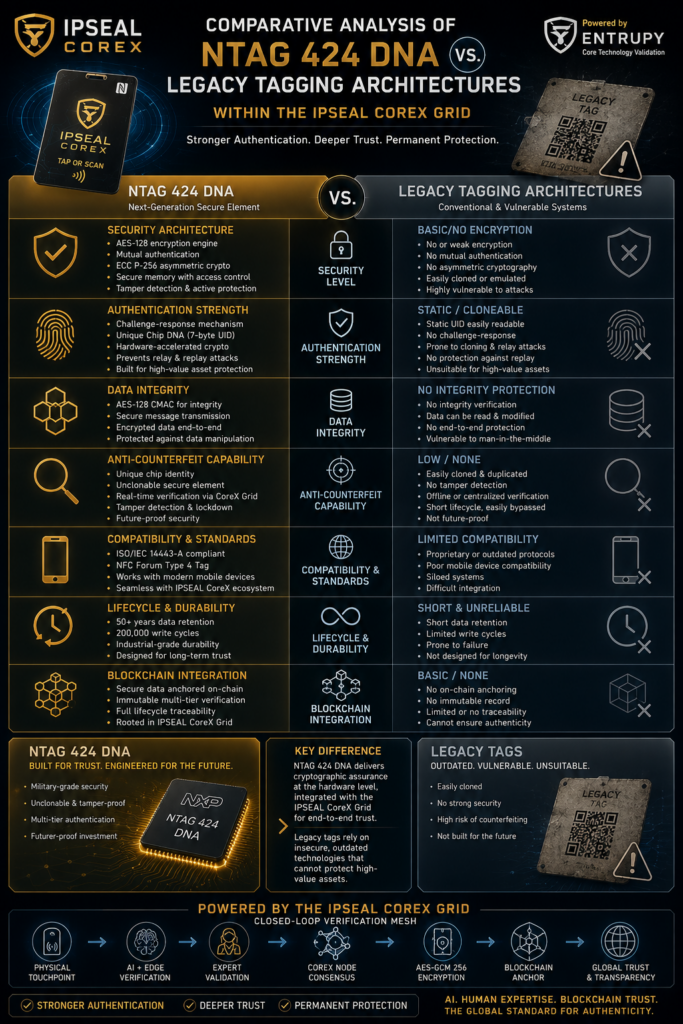
As enterprise supply chains scale into high-velocity global markets, selecting the appropriate physical identifier is a critical operational decision. Historically, brands have relied on static optical codes (standard QR codes, barcodes), passive static RFID/NFC chips, or physical anti-tamper holograms. However, sophisticated counterfeit rings now routinely bypass these legacy mechanisms through optical cloning, signal emulation, and physical transplanting. To demonstrate why cryptographic hardware represents the ultimate physical security tier, IPSEAL.NET provides a detailed comparative architectural analysis. Driven by the high-performance Ipseal CoreX platform and verified under our proprietary entity, Entrupy, this paper highlights the clear technical superiorities of the NTAG 424 DNA chip over traditional tagging formats.
1. Architectural Comparison Matrix
The structural limitations of traditional tagging modalities contrast sharply with dynamic, bank-grade hardware enclaves:
┌────────────────────────────────────────────────────────────────────────────────────────┐
│                        PHYSICAL IDENTIFIER COMPARISON MATRIX                           │
├───────────────────────┬──────────────────┬───────────────────┬─────────────────────────┤
│ ARCHITECTURAL FEATURE │ STATIC QR / PRINT│ PASSIVE STATIC NFC│ NTAG 424 DNA ENCLAVE    │
├───────────────────────┼──────────────────┼───────────────────┼─────────────────────────┤
│ Cryptographic Signature│ Static Text / URL│ Fixed UID / Serial│ Dynamic SUN (AES-128)   │
│ Replay Attack Defense │ ZERO (Copyable)  │ LOW (Emulatable)  │ ABSOLUTE (Dynamic Nonce)│
│ Physical Cloning Risk │ Extremely High   │ High              │ Zero (On-Chip Keys)     │
│ Counter Invalidation  │ None             │ None              │ Hardware Tap Counter    │
│ Field Scan Speed      │ 1-2 Seconds      │ < 100ms           │ Sub-Millisecond         │
└───────────────────────┴──────────────────┴───────────────────┴─────────────────────────┘
2. Deep Technical Superiorities of NTAG 424 DNA Integration
Within the Ipseal CoreX powered by Entrupy ecosystem, the NTAG 424 DNA chip solves the fundamental security gaps inherent in older identification methods:
┌────────────────────────────────────────────────────────────────────────┐
│                   NTAG 424 DNA DYNAMIC HANDSHAKE                       │
│                                                                        │
│   [ Physical Scan Event ]                                              │
│             │                                                          │
│             ▼                                                          │
│   [ On-Chip AES-128 Hardware Engine ]                                  │
│             │                                                          │
│             ▼                                                          │
│   [ Generates Dynamic SUN Payload + Monotonic Tap Counter ]            │
│             │                                                          │
│             ▼                                                          │
│   [ CoreX Edge Node Decrypts & Verifies State Mathematics ]            │
└────────────────────────────────────────────────────────────────────────┘
A. Dynamic SUN Encryption vs. Static Code Cloning
-
The Legacy Failure: Static QR codes and basic NFC tags transmit identical data strings on every scan. Counterfeiters simply photograph the QR code or clone the NFC serial number onto cheap commodity tags, attaching them to thousands of replica products.
-
The NTAG 424 DNA Advantage: Utilizing Secure Unique NFC Message (SUN) technology, the chip generates a brand-new, mathematically unique AES-128 cryptographic payload on every single tap. Intercepted transmission payloads are completely useless for replay attacks, rendering tag cloning impossible.
B. Hardware Key Protection vs. Software Emulation
-
The Legacy Failure: Basic RFID and standard NFC tags store identifiers in readable memory banks that can be cloned using inexpensive software emulators.
-
The NTAG 424 DNA Advantage: Private cryptographic keys are permanently locked inside silicon hardware enclaves during factory initialization. The keys never leave the chip; instead, the chip solves localized mathematical challenges on-silicon, ensuring physical security integrity.
3. Multi-Token Mesh Synergy and Enterprise Scale
Integrating NTAG 424 DNA enclaves into our multi-tier node architecture delivers a comprehensive security shield for enterprise asset management:
┌────────────────────────────────────────────────────────────────────────┐
│                     HARDWARE ADVANTAGE MATRIX                          │
│                                                                        │
│  1. IMPERMABLE CLONE DEFENSE                                           │
│     Generates dynamic, time-sensitive cryptographic proofs per tap.    │
│                                                                        │
│  2. AES-GCM 256 PARENT-CHILD LOCKING                                   │
│     Binds outer dynamic chips to internal microstructural vectors.     │
│                                                                        │
│  3. IMMUTABLE BLOCKCHAIN STATE TRANSITIONS                             │
│     Compresses dynamic tap telemetry into permanent ledger roots.      │
└────────────────────────────────────────────────────────────────────────┘
-
Elimination of Tag Transplanting: Within the Ipseal CoreX grid, the NTAG 424 DNA dynamic chip (Parent Key) executes a joint cryptographic handshake with internal component tokens or material feature vectors (Child Keys). If a bad actor peels the chip off an authentic product and pastes it onto a fake, the internal handshake breaks, and the network flags the asset instantly.
-
Sub-Millisecond Edge Validation: Decryption of the dynamic SUN payload occurs locally at independent validation nodes in sub-milliseconds, allowing logistics handlers and consumers to authenticate goods using standard smartphones without system latency.
-
Optimized Blockchain Logging: Managed under our Entrupy protocols and processed by the 10th-Generation Central Core, millions of dynamic hardware state changes are compressed into compact cryptographic roots, maintaining a lean, scalable ledger footprint.
Conclusion: The Definitive Gold Standard for Physical Security
While static QR codes and legacy NFC tags serve basic tracking functions, they fail under targeted anti-counterfeiting requirements. By deploying NTAG 424 DNA chips as the hardware foundation of the Ipseal CoreX platform, powered by Entrupy, our architecture establishes an uncopyable bridge between physical assets and digital passports. This optimized network framework ensures that physical tags cannot be cloned, asset integrity remains completely verifiable, and global enterprise trust operates with fluid velocity across all international borders.
