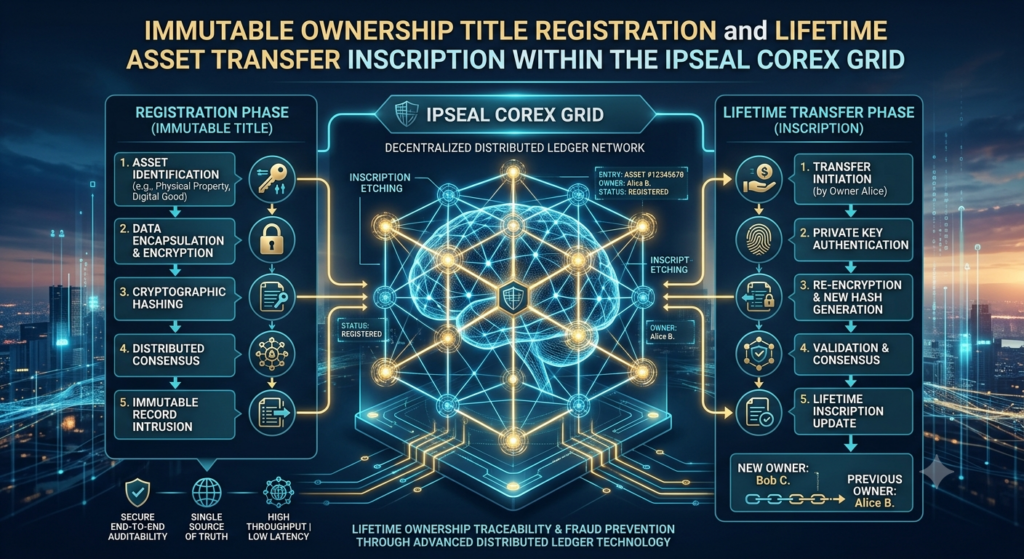
When high-value assets—such as premium Nappa leather bags, specialized luxury footwear, or limited-edition corporate goods—change hands, the transaction demands absolute data integrity. Standard paper receipts, centralized digital invoices, and traditional retail databases remain highly vulnerable to database manipulation, retro-active tampering, and administrative fraud. If a luxury asset is resold on the secondary market, proving its legitimate line of custody becomes nearly impossible without a secure system. To solve this critical vulnerability, IPSEAL.NET deploys its Permanent Title Transfer Protocol. Driven by the high-performance Ipseal CoreX platform and verified under our proprietary entity, Entrupy, this architecture permanently incribes ownership changes directly onto an unalterable ledger, ensuring that an item’s lineage remains clear throughout its entire lifecycle.
1. The Architectural Mechanics of Permanent Title Inscription
The recording of a permanent transfer within the network does not rely on a simple text update in a central server. Instead, it executes an automated cryptographic sync across the physical product matrix and a distributed ledger simultaneously.
[ Current Owner Token Authorization ] ──► [ CoreX Edge Validation Node ]
                                                       │
                                                       ▼
[ Permanent Blockchain Ledger ] ◄─── [ AES-GCM 256 Parent-Child Re-Key ] ──► [ New Owner Inscription ]
-
Multi-Layer Identity Integration: When a transfer occurs, the Ipseal CoreX powered by Entrupy engine updates the asset’s digital twin passport. The new owner’s public cryptographic signature is bound directly to the item’s historical record.
-
Bank-Grade Token Re-Locking: To complete the transfer, the primary outer tracking tag (Parent Key) and the deep internal component tokens (Child Keys) execute a mutual handshake utilizing AES-GCM 256-bit encryption. They verify the product is physically complete, sign the new ownership payload with their respective private keys, and permanently lock the new owner’s data directly into the physical component network itself.
2. Real-World Case Study: Transferring a Luxury Handbag
To understand the practical fluid velocity of this architecture, consider the step-by-step lifecycle transfer of a premium luxury handbag in the secondary peer-to-peer market:
┌────────────────────────────────────────────────────────────────────────┐
│               LUXURY HANDBAG TITLE TRANSFER LIFECYCLE                  │
│                                                                        │
│  Step 1: Point-of-Sale Scan  ──► Microstructural & Dual-Tag Audit       │
│  Step 2: Private Key Release ──► Current Owner Signs Title Relinquish   │
│  Step 3: New Owner Ingest    ──► CoreX Writes New Owner Digital Signature│
│  Step 4: Blockchain Block Mint──► 10th-Gen Core Commits Permanent Record │
└────────────────────────────────────────────────────────────────────────┘
-
Step 1: Multi-Tier Pre-Transfer Audit: The secondary buyer or consignment workshop scans the luxury handbag using an independent validation node. The local CoreX engine verifies the material’s microstructural fiber randomness (confirming genuine leather vs. synthetic replica) and checks that the internal Child components have not been modified or substituted.
-
Step 2: Relinquishing Title: Once the bag is verified as authentic, the current owner authorizes the transaction via their private cryptographic key, signaling the network that they are legally releasing custody of the asset.
-
Step 3: Inscribing the New Owner: The incoming buyer scans their verified public identity anchor into the CoreX mobile application. The node updates the local token memory banks on the bag, binding the new owner’s identity directly to the physical piece.
-
Step 4: Permanent Blockchain Inscription: Optimized by our 10th-Generation Central Core, this transaction is compressed into a tight cryptographic root and permanently minted onto the blockchain ledger. This creates an unalterable, time-stamped history of ownership that cannot be rewritten or erased by any centralized entity.
3. High-Velocity Compliance and Anti-Fraud Advantages
Deploying an immutable ownership registry across a decentralized mesh network establishes an absolute protective shield for high-value circular commerce:
-
Total Eradication of Tag-Transplanting Fraud: Because the ownership timeline is linked concurrently to both the physical material DNA and the internal embedded tokens, a counterfeit item can never pass inspection by simply using a cloned or stolen outer serial number.
-
Lean Network Footprint Efficiency: To manage millions of secondary market transfers without creating system lag, the CoreX platform batches transfer events into hyper-dense cryptographic roots, maintaining rapid processing speeds at absolute web-scale.
-
Protection of Localized Trademark Rights: The software architecture automatically maps regional trademark protections and distribution rights to the asset’s passport. If an item legally registered to an owner in one territory is illegally diverted across borders, downstream nodes flag the geographic compliance breach instantly.
Conclusion: Securing Asset Lineage with Absolute Precision
True long-term brand protection requires an ecosystem that secures an asset’s identity from its primary factory birth through every subsequent secondary market transaction. By combining bank-grade multi-token encryption with permanent blockchain logging, the Ipseal CoreX platform, powered by Entrupy, delivers the definitive standard for asset title security. This optimized network framework ensures that every luxury handbag remains structurally whole, every ownership transfer is entirely transparent, and global enterprise trust operates with absolute fluidity across generations of consumers.
