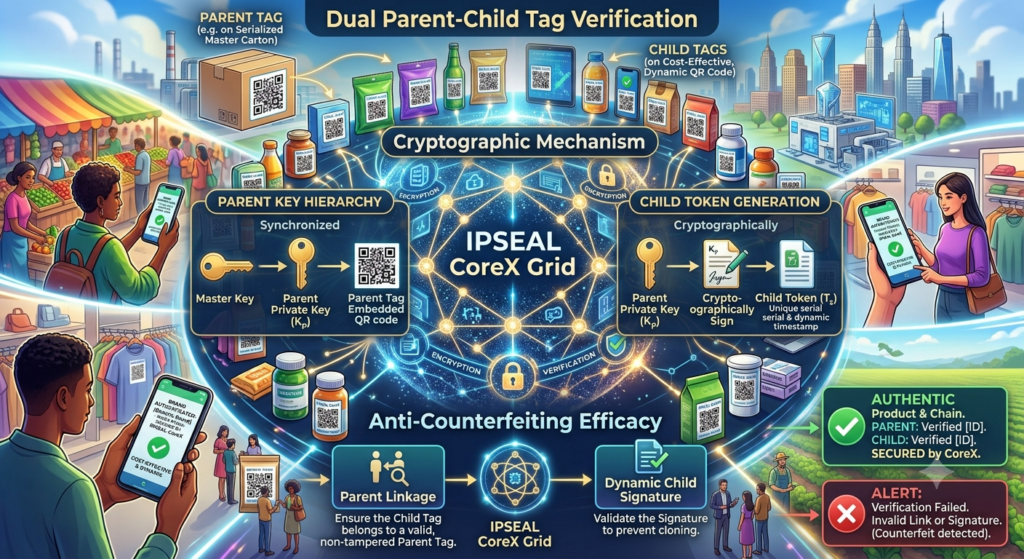
In the global supply chain defense landscape, traditional security labels fail because they treat an asset as a single, isolated object. Counterfeiters exploit this limitation by peeling authentic tracking tags off real products and placing them onto fake goods, or by executing partial substitution fraud—swapping high-value internal components with cheap imitations while leaving the outer authentic shell intact. To completely eliminate these critical security vulnerabilities, IPSEAL.NET deploys its Dual Parent-Child Tag Verification Architecture. Driven by the high-performance Ipseal CoreX platform and verified under our proprietary entity, Entrupy, this system establishes an inseparable, multi-token relationship between two or more structural points of an asset, creating an uncopyable shield against fraud.
1. The Anatomy of Dual Tag Verification: How the Multi-Token Shield Works
Instead of relying on a single point of failure, the Ipseal CoreX engine splits an asset’s identity into two distinct, interdependent cryptographic layers that must continuously validate one another:
┌────────────────────────────────────────────────────────────────────────┐
│                   DUAL TAG CRYPTOGRAPHIC VERIFICATION                 │
│                                                                        │
│   [PARENT TAG (Chassis/ID Shell)]                                      │
│                ▲                                                       │
│                │  ◄─── Bank-Grade AES-GCM 256 Mutual Challenge ───►    │
│                ▼                                                       │
│   [CHILD TAG (Internal/Sub-Component)]                                 │
│                │                                                       │
│                ▼                                                       │
│   [CoreX Edge Matrix Processor] ──► [Instant Blockchain Consensus Root]│
└────────────────────────────────────────────────────────────────────────┘
-
The Parent Tag (The Identity Anchor): Fixed to the primary body, chassis, or outer shell of the product, this token holds the primary master identity, regional trademark compliance data, and historical ownership logs.
-
The Child Tag (The Integrity Bond): Embedded deep within an internal component, vital sub-assembly, or accompanying high-value accessory, this token holds a corresponding asymmetric cryptographic segment.
-
Bank-Grade Mutual Challenges: When an independent validation node scans the asset, the Parent and Child tags do not merely transmit static serial numbers. Utilizing AES-GCM 256-bit encryption, they execute a mutual cryptographic challenge-response handshake. The Parent tag asks the Child tag to solve a complex mathematical equation, and vice versa. Unless both calculations balance perfectly in real time, the validation fails.
2. Absolute Anti-Counterfeiting Defenses Enabled by Dual Tokens
The Ipseal CoreX powered by Entrupy dual-tag handshake provides precise protection against the most advanced tampering methods used by modern counterfeiters:
A. Total Elimination of “Tag Peeling” & Transplanting Fraud
If a fraudster carefully removes an authentic Parent tag from a genuine product and pastes it onto a counterfeit replica, the attack fails immediately. When scanned at an independent node, the transplanted Parent tag will attempt to challenge the missing or copied internal Child tag. Because the unique mathematical bond is broken, the local CoreX engine instantly flags the mismatch, exposes the transplant attempt, and changes the product’s digital passport to “Compromised.”
B. Complete Eradication of Part-Substitution Fraud
In segments like premium fashion or technical manufacturing, bad actors often remove authentic internal linings, movements, or straps to sell them separately on the gray market, replacing them with fake parts. Dual tag verification prevents this entirely. Because the internal Child tag is continuously cross-audited by the outer Parent tag, any unauthorized component swap instantly breaks the cryptographic chain, blocking the item from passing quality control or retail distribution.
3. Distributed Edge Enforcement and Continuous Blockchain Inscription
Our dual-tag verification framework establishes an automated, institutional standard for global asset protection:
┌────────────────────────────────────────────────────────────────────────┐
│                     DUAL ENFORCEMENT STATE MATRIX                      │
│                                                                        │
│  1. MULTI-LAYER HARDWARE LOCKING                                       │
│     Binds outer identity to internal components with zero line-of-sight.│
│                                                                        │
│  2. SUB-MILLISECOND EDGE EXECUTION                                     │
│     Processes dual mutual challenges locally at independent nodes.     │
│                                                                        │
│  3. CRYPTOGRAPHIC ROOT LOGGING                                         │
│     Mints every successful handshake permanently onto the blockchain. │
└────────────────────────────────────────────────────────────────────────┘
-
Zero-Latency Wireless Auditing: By utilizing advanced data-routing protocols, independent edge nodes can read and execute the dual-token handshake in a single wireless pass, completely bypassing the need for time-consuming physical product teardowns.
-
Autonomous Network Herd Immunity: If a cloned or corrupted tag attempts a fraudulent verification event, the local CoreX engine isolates the threat instantly. The malicious signature is shared peer-to-peer across the decentralized network, neutralizing the counterfeit attack vector before it can spread.
-
Unalterable Chain of Custody: Every successful dual-tag handshake is compressed into a tight cryptographic root by our 10th-Generation Central Core and permanently written to the blockchain ledger, anchoring the physical item’s structural wholeness to an uncopyable, lifetime timeline.
Conclusion: Setting the Ultimate Standard for Multi-Token Integrity
True security cannot rely on a single defensive line; it requires an interconnected network of internal and external validation. By deploying Dual Parent-Child Tag Verification through the decentralized computing power of the Ipseal CoreX platform, our architecture powered by Entrupy establishes a bulletproof environment for global trade. This optimized system ensures that physical goods cannot be separated, modified, or cloned, locking absolute authenticity into every layer of the asset at web-scale.
