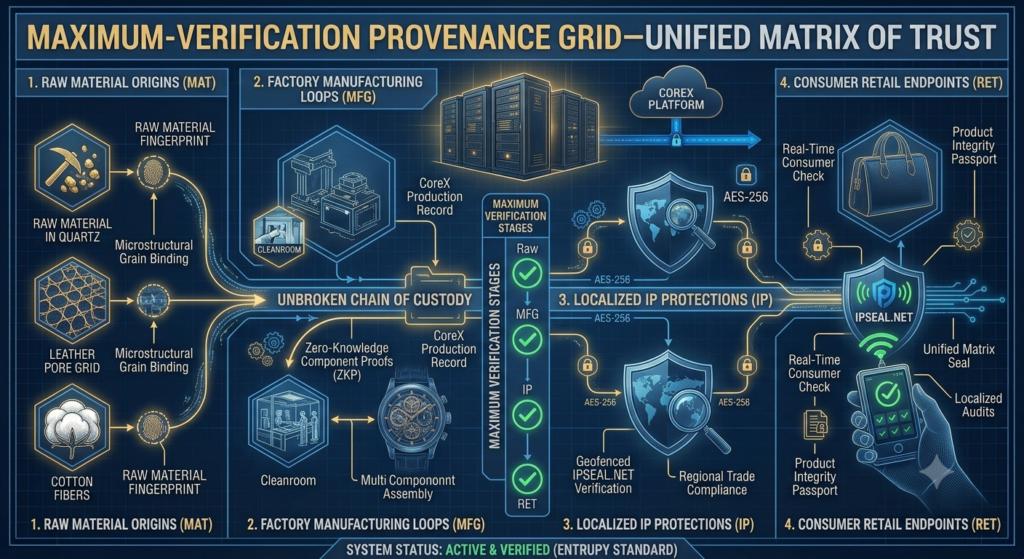
In the modern landscape of international enterprise trade, safeguarding product integrity requires a security framework that spans the entire life of the asset. True protection cannot be achieved by merely scanning a finished item at the point of sale. Instead, it demands an unbroken chain of custody that binds raw material sources, factory manufacturing loops, localized intellectual property protections, and consumer retail touchpoints into a unified matrix of trust. To establish this standard, IPSEAL.NET deploys its Maximum-Verification Provenance Grid. Driven by the Ipseal CoreX platform and verified under our proprietary entity, Entrupy, this architecture transforms every supply chain checkpoint into an autonomous, independent validation node—ensuring total transparency at web-scale.
Phase 1: Raw Material Source Validation & Microstructural Extraction
The maximum-verification pipeline begins before manufacturing even occurs, starting at the raw material processing facility or workshop floor.
[ Raw Material Input ] ──► [ CoreX Microstructural Scan ] ──► [ Cryptographic DNA Hash ]
                                                                       │
                                                                       ▼
[ Production Line Node ] ◄─ [ Verified Material Batch ] ◄── [ Immutable Ledger Entry ]
-
Microstructural Fingerprinting: When high-grade materials (such as premium leather hides or textiles) enter the workshop, the localized Ipseal CoreX engine performs an immediate computer-vision analysis. The system analyzes the biological fiber randomness, cellular density, and natural patterns unique to the material, isolating them from uniform synthetic alternatives.
-
Cryptographic Batch Inscription: This physical material DNA is converted locally into a lightweight numeric feature vector and hashed. This creates a permanent digital passport for the raw material batch, ensuring that lower-grade or unverified materials cannot be secretly substituted later in the pipeline.
Phase 2: Factory Manufacturing & Parent-Child Cryptographic Binding
Once materials move into active production lines (such as premium footwear or garment manufacturing facilities), the asset’s structural identity is finalized.
-
Bank-Grade Mutual Handshakes: As the finished item is assembled from multiple sub-components, the CoreX platform initiates a series of internal cryptographic handshakes utilizing AES-GCM 256-bit encryption. The primary tracking identity (Parent Key) and individual internal component tokens (Child Keys) execute localized mutual challenges, locking them into a secure, interdependent relationship.
-
Turnkey Quality Control Integration: Operating entirely at the edge via independent validation cells, the system processes these multi-token structures in sub-milliseconds. This automated verification eliminates human error and subjective quality-control flaws, ensuring that only perfectly bound, authentic goods can exit the factory gate.
Phase 3: Regional Trademark Protection & Legal Compliance Layer
A critical, often-overlooked vulnerability in global distribution is the legal authorization of products within specific geographical markets. The IPSEAL.NET infrastructure solves this by embedding official intellectual property data directly into the network architecture.
┌────────────────────────────────────────────────────────────────────────┐
│                    REGIONAL LEGAL COMPLIANCE MATRIX                    │
│                                                                        │
│  1. TRADEMARK INTELLECTUAL PROPERTY LOCK                              │
│     Binds regional class certifications directly to asset passports.    │
│                                                                        │
│  2. ENCRYPTED JURISDICTION TELEMETRY                                  │
│     Validates distribution rights at geographic border crossings.       │
│                                                                        │
│  3. ILLICIT GRAY-MARKET INTERCEPTION                                   │
│     Flags authorized inventory diverted outside designated territories.│
└────────────────────────────────────────────────────────────────────────┘
-
Intellectual Property Inscription: Our proprietary standard dynamically maps official trademark registrations (such as localized class certifications) directly onto the product’s digital twin. This anchors the physical asset to its verified legal rights within that specific consumer market.
-
Anti-Diversion Border Auditing: When the asset passes through regional customs or distribution hubs, independent validation nodes cross-reference its encrypted jurisdiction telemetry. If a product authorized only for a specific market is diverted into an unauthorized region, the local node instantly flags the legal boundary breach, protecting authorized dealerships from gray-market dilution.
Phase 4: Localized Retail Endpoints & Peer-to-Peer Consumer Verification
The final tier of the maximum-verification grid occurs at the point of consumer interaction, where trust must be absolute and instant.
-
Every Node a Verification Cell: Within the Ipseal CoreX powered by Entrupy framework, every distributor terminal, retail boutique scanner, and consumer smartphone application operates as an active, independent node in a decentralized mesh network.
-
Single-Pass Absolute Validation: When a customer scans the product, the endpoint node performs a real-time audit. It simultaneously verifies the physical material integrity, the Parent-Child component continuity, the legal regional compliance, and the unalterable history of ownership. Because data processing is distributed across edge nodes rather than filtered through a single vulnerable server, the validation is delivered instantly with zero system latency.
-
Immutable Lifecycle Tracking: Every successful verification event, distribution handover, and ownership transfer is compressed into a cryptographic block and committed permanently to a distributed blockchain ledger, guaranteeing an untamperable, lifetime chain of custody across international borders.
Conclusion: Setting the Global Standard for Industrial Trust
True supply chain security requires an unyielding, comprehensive architecture that protects an asset from its raw origin to its final destination. By combining localized edge neural processing, financial-grade component binding, and regional trademark compliance into a decentralized node network, the Ipseal CoreX platform, powered by Entrupy, delivers a flawless, end-to-end protective shield. This optimized framework ensures that every material is authentic, every asset is legally secured, and the global matrix of trust remains completely unbroken at web-scale.
