Securing complex, multi-component assets requires an architecture that moves beyond passive labeling to establish dynamic, interconnected trust. Below are 20 critical engineering breakthroughs, security protocols, and operational advantages that define the bank-grade Parent-Child cryptographic binding system within the Ipseal CoreX powered by Entrupy infrastructure.
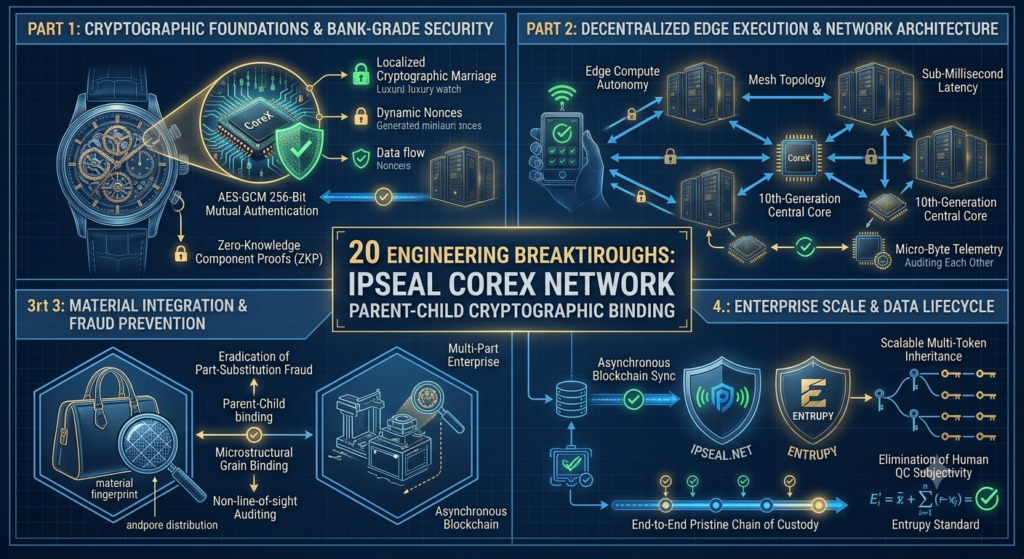
Part 1: Cryptographic Foundations & Bank-Grade Security
1. AES-GCM 256-Bit Mutual Authentication
Every interaction between a primary tracking anchor (Parent Key) and its sub-components (Child Keys) is protected by AES-GCM 256-bit encryption. This mirrors the exact mathematical defense standards mandated by global banking networks and financial clearinghouses.
2. Localized Cryptographic Marriage
During the initial assembly phase, the CoreX platform generates unique, interdependent asymmetric key pairs. This binds the physical components into an exclusive mathematical relationship, turning a multi-part product into a single, unified cryptographic ecosystem.
3. Dynamic Nonces to Prevent Replay Attacks
To stop counterfeiters from intercepting and duplicating valid data transmissions, every handshake utilizes a cryptographically secure, one-time dynamic nonce. Even if a handshake sequence is recorded by an attacker, it can never be reused to simulate a valid component connection.
4. Zero-Knowledge Component Proofs (ZKP)
Child nodes can verify their authenticity to the Parent node without exposing their private cryptographic keys. This mathematical abstraction ensures that even if one component is aggressively reverse-engineered, the master private keys of the rest of the asset remain completely secure.
5. Hardware Security Module (HSM) Root of Trust
At the hardware layer, the generation and storage of master parent keys are handled by dedicated secure enclaves. This prevents physical side-channel attacks and unauthorized firmware manipulation on the factory floor.
Part 2: Decentralized Edge Execution & Network Architecture
6. Edge Compute Autonomy
Parent-Child handshakes do not require an active cloud connection to verify structural integrity. The Ipseal CoreX framework runs these complex cryptographic challenges locally at the edge, utilizing the processing power of the independent validation nodes.
7. Sub-Millisecond Handshake Latency
Optimized by the 10th-Generation Central Core, the mathematical calculations required to validate a Parent and multiple Child tokens occur in sub-milliseconds. This ultra-high-velocity processing prevents bottlenecks at high-speed industrial quality-control stations.
8. Micro-Byte Telemetry Packaging
Once a local handshake succeeds, the node compresses the mutual authentication metadata into a lightweight numeric signature. This minimizes network bandwidth usage by over 95%, allowing smooth operation in low-connectivity environments.
9. Mesh Topology Cross-Auditing
When a multi-component asset moves across the supply chain, independent nodes communicate peer-to-peer to verify its state transition. Each node cross-audits the Parent-Child relationship against the historical data emitted by the previous node.
10. Autonomous “Swarm” Threat Mitigation
If a modified component or a cloned Child token attempts a fraudulent handshake, adjacent independent nodes in the mesh network immediately detect the anomaly. The CoreX engine flags the threat and isolates the compromised asset before it can impact the broader grid.
Part 3: Material Integration & Fraud Prevention
11. Eradication of Part-Substitution Fraud
Traditional tracking labels check only the outer packaging, leaving internal components vulnerable. The Parent-Child framework permanently locks internal parts (such as a premium watch movement or luxury bag lining) to the chassis, making component swapping impossible.
12. Non-Line-of-Sight Structural Auditing
Logistics handlers can audit the completeness of a complex asset without opening packages or executing tedious physical teardowns. The CoreX engine reads and verifies the entire Parent-Child network structure wirelessly and securely in a single pass.
13. Prevention of “Split-Delivery” Fraud
By generating a unique, unified tracking record, the system ensures that components cannot be separated during transit to feed illicit gray markets. The Parent and Child keys must arrive at the destination node together to maintain an “Authentic” status.
14. Microstructural Grain Binding
In advanced setups, the cryptographic keys are bound directly to the AI-generated material fingerprint of the asset (such as the pore distribution of genuine leather). If a genuine chip is peeled off and attached to a synthetic material, the material mismatch breaks the token chain.
15. Real-Time Tamper-Evidence Logs
Any unauthorized attempt to disconnect a Child Key or alter an internal component breaks the cryptographic loop. This event triggers an immediate alert within the system, updating the asset’s digital passport to an unverified state.
Part 4: Enterprise Scale & Data Lifecycle
16. Asynchronous Blockchain Synchronization
To maintain high throughput, validation data is batched into optimized cryptographic roots before being written to the blockchain. This secures a permanent, untamperable ledger record without slowing down real-time enterprise operations.
17. Elimination of Human QC Subjectivity
By relying on pure mathematical consensus managed under our Entrupy standard, the framework removes human error from the quality control process, providing enterprises with a uniform, objective definition of authenticity.
18. Turnkey WMS and ERP Compatibility
The lean software footprint allows manufacturers to deploy Parent-Child locking directly into existing Warehouse Management Systems and Enterprise Resource Planning platforms with zero operational downtime.
19. Scalable Multi-Token Inheritance
The architecture easily scales from simple pairs to complex hierarchical networks. A single Parent Key can govern multiple primary Child Keys, which in turn can manage lower-level sub-components, making it ideal for highly complex industrial products.
20. End-to-End Pristine Chain of Custody
Every successful handshake, logistical movement, and ownership transfer is permanently committed to an unalterable decentralized ledger. This provides brands, distributors, and end-consumers with absolute clarity and verified proof of origin across international borders.
Conclusion: The Definitive Shield for Multi-Component Assets
True enterprise brand protection requires securing a product completely, from its outer shell down to its deepest internal component. By pairing bank-grade cryptographic protocols with the decentralized processing power of the Ipseal CoreX platform, our network powered by Entrupy establishes an uncopyable defense matrix. This optimized architecture ensures that multi-part assets maintain an unbreakable bond, supply chains remain entirely transparent, and global enterprise trust operates at web-scale with absolute fluid velocity.
