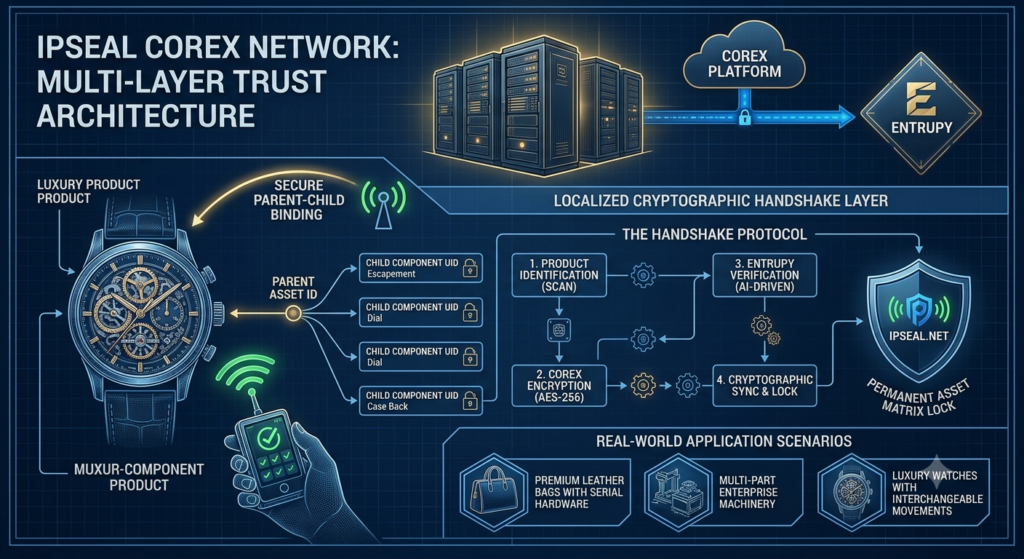
In high-value product security and industrial asset manufacturing, protecting multi-component systems (such as luxury watches with interchangeable movements, premium leather bags with serial hardware, or multi-part enterprise machinery) requires absolute cryptographic sync. Standard tracking labels validate only the outer shell, leaving internal components completely vulnerable to part-substitution fraud and illicit tampering. To secure these complex relationships, IPSEAL.NET deploys an elite, high-security infrastructure: Bank-Grade Parent-Child Cryptographic Binding. Driven by the Ipseal CoreX platform and verified under our proprietary entity, Entrupy, this architecture establishes secure, localized handshakes to ensure every product component remains permanently locked within a unified matrix of trust.
1. The Mechanics of Parent-Child Cryptographic Locking
The Parent-Child security layer moves away from basic data links to establish an independent, multi-token cryptographic marriage. Every multi-component asset is treated as a secure ecosystem containing a primary tracking anchor (the Parent Key) and secondary component tokens (the Child Keys).
┌────────────────────────────────────────────────────────────────────────┐
│               BANK-GRADE PARENT-CHILD CRYPTOGRAPHIC LOCK               │
│                                                                        │
│     [Parent Key Anchor] ◄─── AES-GCM 256 Handshake ───► [Child Key 01] │
│              │                                               │         │
│              ▼                                               ▼         │
│     [CoreX Edge Matrix] ──────────────────────────────► [Child Key 02] │
│              │                                                         │
│              ▼                                                         │
│     [Entrupy Verification Cloud] ──► [Asymmetric Blockchain Ledger]     │
└────────────────────────────────────────────────────────────────────────┘
-
Asymmetric Key Pair Generation: During the initial workshop or manufacturing stage, the CoreX platform generates unique, interdependent cryptographic key pairs for the components. The Parent Key (e.g., embedded in the main body or digital identity tag) acts as the local validation root, while each Child Key (e.g., embedded inside a watch movement, luxury lining, or sub-accessory) holds a dedicated cryptographic segment.
-
Bank-Grade Mutual Authentication: To verify structural integrity, the components execute a mutual authentication routine utilizing AES-GCM 256-bit encryption—the same algorithmic standard mandated by global banking networks and financial clearinghouses. The Parent and Child keys challenge each other locally; unless both mathematical equations balance perfectly, the asset state remains locked.
2. Real-Time Dynamic Telemetry and Threat Interception
Within an Ipseal CoreX powered by Entrupy infrastructure, Parent-Child handshakes occur instantly across independent validation nodes, keeping the entire asset network synchronized.
A. Non-Line-Of-Sight Cross-Auditing
When an asset passes through a logistics hub or a point of inspection, the localized CoreX neural engine scans the Parent and Child identities in parallel. It cross-checks their unified cryptographic history without requiring tedious physical teardowns. If a fraudster swaps an authentic interior component (Child Key) with a counterfeit replica, the local handshake breaks instantly. The CoreX engine flags the modification and blocks the entire asset validation chain.
B. High-Velocity State Synchronization
Every successful Parent-Child handshake generates a unique, one-time telemetry hash. The 10th-Generation Central Core routes this data package smoothly across the network, verifying that the components have moved together through the supply chain. This real-time audit trail prevents sophisticated “split-delivery” fraud, where genuine components are separated from their chassis during transit to feed gray markets.
3. Financial-Grade Governance and Immutable Blockchain Registry
Our cryptographic binding framework establishes a lean, institutional standard for multi-component compliance and absolute asset protection:
┌────────────────────────────────────────────────────────────────────────┐
│                   CRYPTOGRAPHIC INTEGRITY MATRIX                       │
│                                                                        │
│  1. AES-GCM 256 CRYPTO ELEMENT                                         │
│     Enforces bank-grade mutual challenges across internal components. │
│                                                                        │
│  2. PARALLEL COREX COMPONENT TELEMETRY                                 │
│     Performs single-pass validation of multi-token asset structures.   │
│                                                                        │
│  3. CRYPTOGRAPHIC BATCH MINTING                                        │
│     Locks component marriage records onto a permanent ledger.          │
└────────────────────────────────────────────────────────────────────────┘
-
Elimination of Security Vulnerabilities: By removing human oversight from the assembly line and relying on automated financial-grade math managed under our Entrupy standard, brands secure an absolute, uncopyable line of defense.
-
Lean Blockchain Data Optimization: Instead of creating bloated logs for every single internal component, the CoreX platform aggregates the verified Parent-Child telemetry into a unified cryptographic block, committing a clean, permanent record to the blockchain ledger.
-
Seamless Industrial Integration: The standardized software footprint allows luxury workshops and high-tech manufacturers to implement Parent-Child locking directly into their existing production systems with zero operational downtime.
Conclusion: Securing Complex Products with Financial-Grade Precision
True enterprise brand protection requires securing a product completely, from its outer shell down to its deepest internal component. By pairing bank-grade AES-GCM 256-bit encryption with the advanced network routing of the Ipseal CoreX platform, our infrastructure powered by Entrupy sets a new benchmark for physical-to-digital security. This optimized framework ensures that every multi-part asset maintains an uncopyable bond, every supply chain interaction is transparent, and absolute network trust remains completely unbroken at web-scale.
